Taking OOH to the Next Stage The Challenge of Developing Reach Optimization Logic for LIVE BOARD
LIVE BOARD has leveraged NTT DOCOMO's location data and other resources to achieve highly accurate targeting delivery, with its strength in viewable ad impression measurement (VAC). Through joint development with ALGORITHMIC NITROUS, Inc. and INSIGHT LAB, Inc., we have developed a new planning logic aimed at maximizing advertising reach in the OOH (Out-of-Home) sector. This enables highly accurate planning not only by optimizing target inclusion rates as before, but also by delivering ads to a greater number of unique users.
This white paper summarizes insights gathered from Nami Ozawa of LIVE BOARD, INC.'s Insight Department, Kyota Ishihara, CEO of ALGORITHMIC NITROUS, Inc., and Hiroki Suzuki of INSIGHT LAB. Inc.'s Data Preparation Department. It covers the background of this initiative, the technical challenges encountered, and the newly derived insights.
■LIVE BOARD's Approach: Challenging Industry Limits
LIVE BOARD Osawa (hereafter Ozawa): Until now, OOH media has often struggled to obtain demographic data on its audience, making planning and media selection primarily based on area impressions the standard approach. However, entering 2025, some media companies are advancing the use of beacon and GPS data, making it increasingly possible to capture demographic attributes such as gender and age. Consequently, data-driven planning and impression-based advertising buying are gradually becoming achievable and precise within the OOH domain as well.
On the other hand, accurately predicting and calculating "reach" (unique users exposed to an ad) remains challenging. Generally, the mainstream approach involves using data from fixed-point (annual) asking surveys to estimate reach figures. However, this calculation method assumes "pure advertising"--where ads run in the same slot for a week--as the baseline. It cannot fully reflect the characteristics of media like LIVE BOARD, which allow flexible delivery designs in reach calculations. As a result, planning often relies on empirical assumptions like "advertising on more surfaces will reach more people." This creates a challenge where reach prediction and calculation methods have not kept up with the advanced delivery technologies of programmatic OOH.
LIVE BOARD utilizes NTT DOCOMO's location data and other resources to capture deep attribute information such as gender, age group, and interests/preferences. Since 2023, planning prioritizing target audience inclusion rates has become the primary delivery method. We have achieved high-precision targeting by selecting relevant media and time slots from over 60,000 screens nationwide. Furthermore, we have established mechanisms for visualizing and calculating reach based on delivery results, delivering advanced OOH value within the industry.
However, our previous system only calculated reach based on the results of distribution to selected media. It did not address the overall optimization perspective of determining which media should be combined and how to maximize reach.
Looking at other media, digital media has seen highly advanced utilization of data concerning contact attributes and reach, operating under a structure premised on one-to-one communication. Because tracking is possible on a per-user basis, advertising menus are finely segmented according to KPIs, enabling planning and delivery designs optimized for each specific objective.
LIVE BOARD also recognized the need to refine its planning and delivery methods to maximize effectiveness for each KPI. This involves drawing on such sophisticated approaches in the digital realm and fully leveraging our core strength: a vast vision network spanning diverse situations.
As the first step, we began developing our "Reach Maximization" logic. For this project, we collaborated with ALGORITHMIC NITROUS, Inc., specializing in mathematical optimization, for the algorithm design, and with INSIGHT LAB, Inc. for the system and operational aspects of the project.
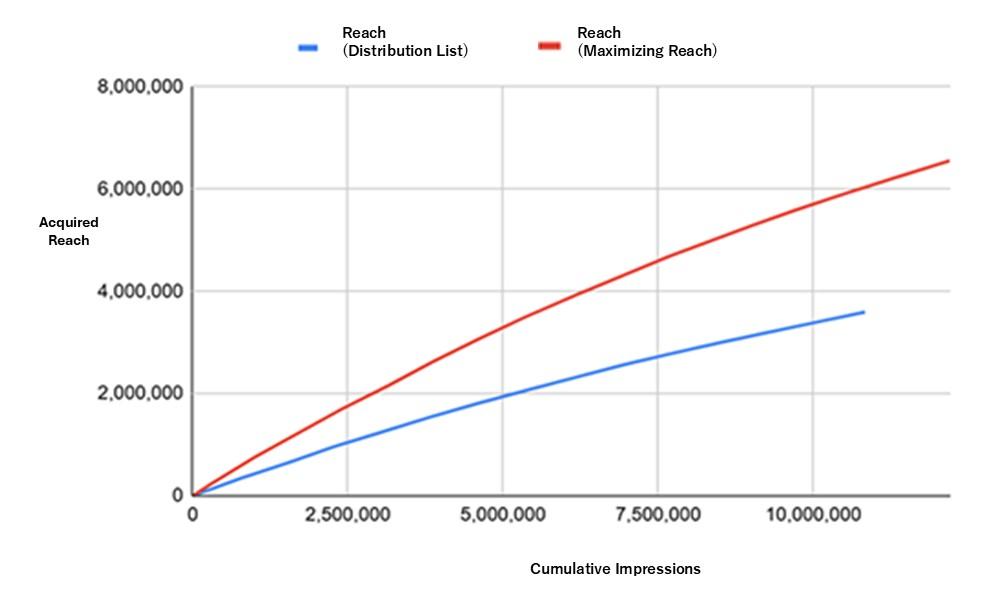
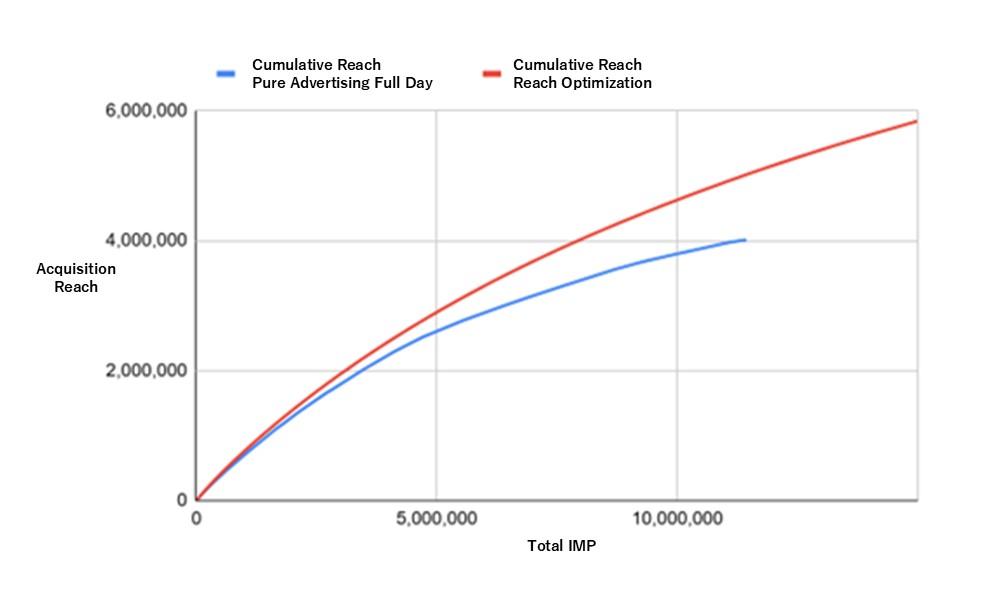
In fact, simulations using the new logic have confirmed significant reach improvements unattainable with conventional methods. For example, when comparing the same number of impressions (10 million impressions), cases have been observed where the reach difference compared to conventional delivery methods reached up to approximately 65%. The introduction of the reach maximization logic enables reach expansion previously unattainable.
■Behind the Scenes of Developing the "Reach Maximization" Logic for OOH
ALGORITHMIC NITROUS, Inc. Mr. Ishihara (hereinafter referred to as Mr. Ishihara):
In the development of this planning logic, I was responsible for modeling reach and designing and implementing the optimization algorithm.
The first task we tackled was modeling reach. LIVE BOARD's impression definition (ad viewable-based/VAC) incorporates the probability that the screen was actually seen = viewability rate. Therefore, we needed to define a reach metric for optimization calculations that aligned with this definition. While providing a mathematically correct definition was straightforward, finding a calculation method that was both mathematically correct and computationally efficient--one that could be computed instantly even in simulations targeting large virtual audiences--proved somewhat challenging.
Regarding reach modeling, when creating data for planning, information about who will be exposed to which screens during the target period is not available at the time of performing optimization calculations for planning. Therefore, when actually utilizing the planning logic, virtual flow and exposure simulation data for the target period is created, and optimization calculations are performed based on this data.
In practice, it is crucial to generate simulation data that statistically aligns with past human flow data and contact histories. Achieving sufficient statistical accuracy inevitably requires large-scale simulation data. Consequently, the optimization algorithm for this planning logic demands high speed performance.
INSIGHT LAB, Inc. Mr. Suzuki (hereinafter Mr. Suzuki): Utilizing NTT DOCOMO's location data and other information, we estimate "when, where, and who is present" and "the probability that person viewed the screen" at the unique user level. In OOH advertising, the same user may encounter ads at multiple locations and times, so deduplication processing is essential for achieving accurate reach.
Mr. Ishihara: Developing the algorithm was challenging in every aspect, from design to acceleration through parallel computing. Reach maximization is a critical issue directly tied to LIVE BOARD's customer value. Therefore, we had to solve an extremely large-scale optimization problem quickly without compromising on accuracy.
LIVE BOARD's media platform offers millions of ad placements, and planning requires deciding which placements to use. The possible combinations and ad patterns are infinite, making it utterly impossible even for modern computers to calculate every single one.
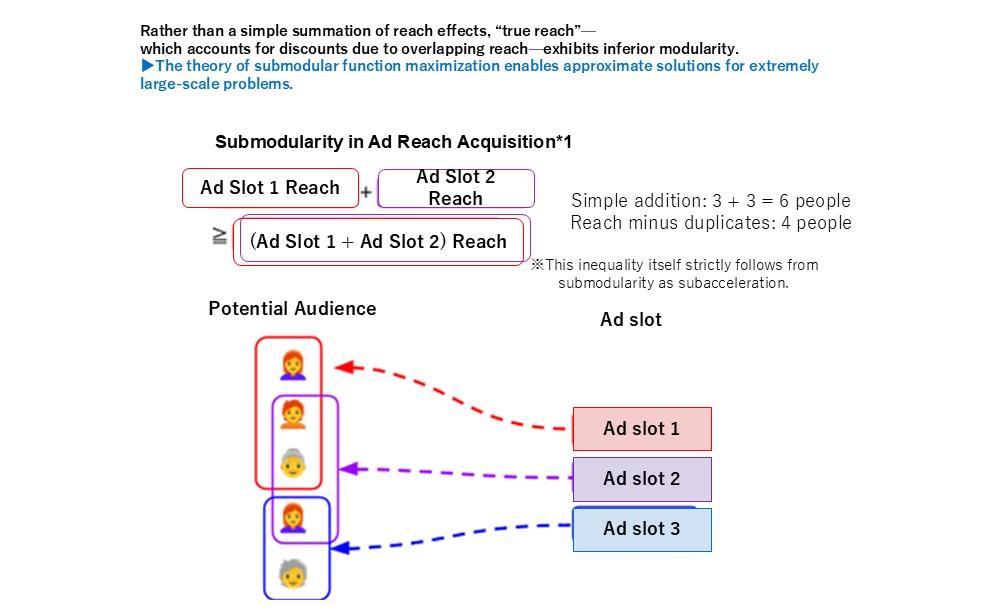
While observing the problem structure and pondering how to solve this extremely large-scale problem without sacrificing accuracy, I realized that this reach maximization problem could be theoretically organized as a "maximization problem of a submodular function." In the field of combinatorial optimization, extensive theoretical research exists on maximizing submodular functions. I discovered an approximation algorithm with theoretical guarantees applicable to this problem. However, for problems as large as the one I was tackling, the algorithm was too slow to be practical as-is. Therefore, I implemented specialized optimizations tailored to this problem, achieving an algorithm that operates quickly while maintaining its theoretical accuracy guarantees. Upon completion, I felt a tremendous sense of accomplishment and relief.
Mr. Suzuki: When generating data for maximizing common reach, one major challenge was the differences in delivery specifications and formats across media platforms. To enable handling all media in a common format, we implemented output processing tailored to each platform and advanced the preparation of data necessary for optimization.
Initially, planning required six hours due to massive data processing, but we have now significantly reduced this to approximately one-third of that time--just two hours--to calculate the plan.
Ozawa: Thanks to the technology provided by the two companies that collaborated with us, we have established a system enabling us to present the optimal reach plan to anyone, anytime. We believe this will significantly contribute to your strategic planning going forward.
■Taking OOH to the Next Stage. New horizons for OOH.
Ozawa: I'll share insights revealed from the optimization results of the reach maximization algorithm.
Insight: Reach increases when combining train interiors, station concourses, and outdoor advertising rather than relying solely on train interior ads.
Ozawa: Assuming the same number of impressions, we found that combining "train interiors + station concourses + outdoor spaces" within the LIVE BOARD network delivers greater reach than distributing "train interiors only" as standalone pure advertising.
In pure advertising sales, where weekly delivery is the standard, train interior ads have long been considered the leading OOH medium for reach. Naturally, in planning based on pure advertising, the medium's inherent characteristics--such as "high ridership = maximum exposure to the most people on a weekly basis"--determine reach. This is undeniable.
On the other hand, when you factor in LIVE BOARD's unique variables--media diversity and flexible delivery timing--combining train interiors, station concourses, and outdoor spaces allows for pinpoint targeting of broadcast slots with distinct user demographics. This significantly boosts reach efficiency.
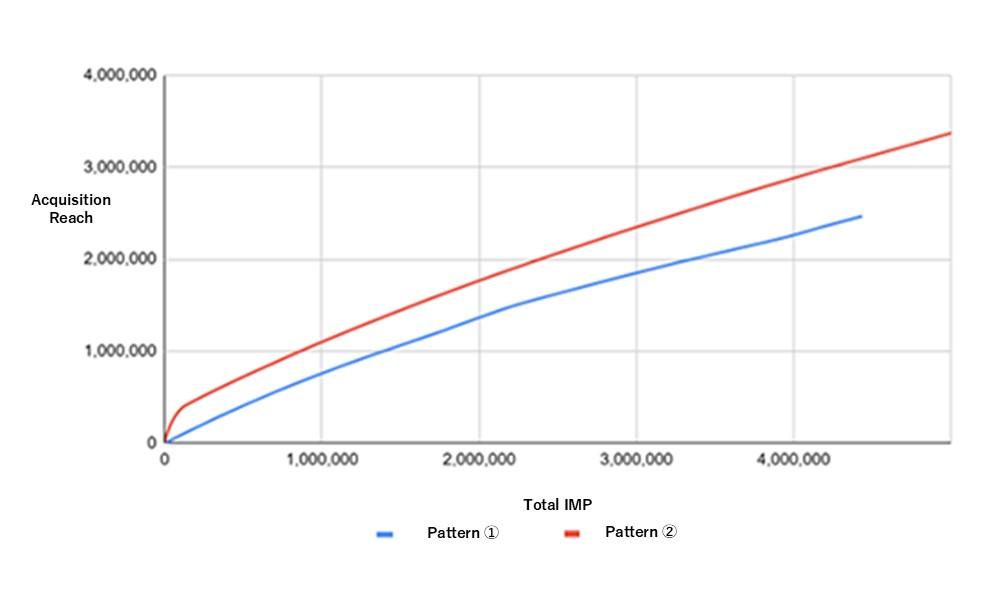
※ Pattern ①: Roll-based distribution inside trains (2 weeks of full-day distribution. Broadcast 4 times per hour)
Pattern ②: Outdoor + Station Interior + Train Interior (Advertising period: 2 weeks. All LIVE BOARD network media)
Furthermore, analysis indicates that if purchase units can be set per broadcast across all media, reach efficiency will improve even further.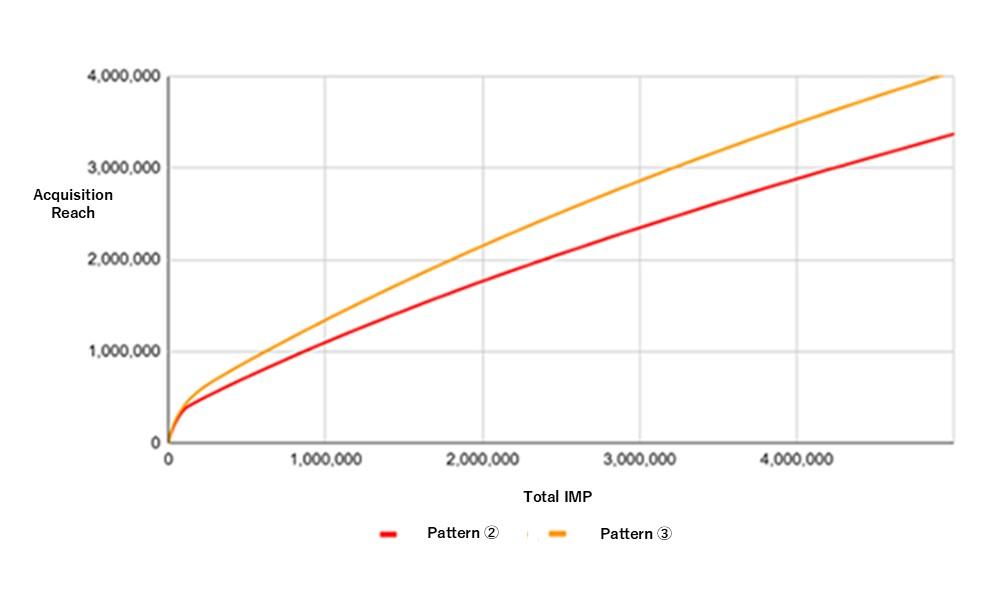
※ Pattern ②: Outdoor + Station Interior + Train Interior (Advertising period: 2 weeks. All LIVE BOARD network media)
Pattern ③: Outdoor + Station Interior + Train Interior (Advertising period: 2 weeks. When purchasing all LIVE BOARD network media on a per-broadcast basis)
Currently, for media connected to LIVEBOARD, outdoor advertising is generally purchased on a per-broadcast basis. However, due to technical constraints such as communication environments, media within certain station premises and train interiors are purchased on an hourly basis.
If this purchase unit can be set per broadcast across all media, it further increases flexibility in delivery timing. This expands options for pinpointing ads to specific broadcast slots with distinct audiences, significantly improving reach efficiency.
Given the high number of rail users, train interior advertising has traditionally been considered the leading OOH medium for reach acquisition in pure advertising sales, which are typically distributed on a weekly basis. However, it has become clear that reach efficiency is determined not by the characteristics of the medium itself, but rather by the diversity of media types and the flexibility of distribution timing.
We feel this is a major discovery that has not been seen in OOH planning until now.
Furthermore, through collaboration with media companies, LIVE BOARD is advancing efforts to refine the purchasing units for station media. For example, for Tokyo Metro's MWV and MSV, as well as Osaka Metro ADERA's Network Vision, purchasing by the single broadcast unit is already possible.
Furthermore, assuming an actual OOH planning scenario where the request is to "maximize reach with a budget of 10 million yen," we verified the comparative differences between a scenario based on pure advertising and one based on the LIVE BOARD network's "reach maximization logic."
・For pure advertising
→ Allocate the majority of the budget to in-train media to maximize reach, then plan outdoor placements with the remaining budget.
Media: Train + Outdoor
Duration: 1 week (full-day placement)
・For LIVE BOARD Network
→ Utilizes all vehicles within trains/outdoors/station premises. Planning based on "Maximum Reach Logic".
Media: Trains + Outdoors + Station Premises
Duration: 2 weeks (calculated at 2.4 yen per impression)
Comparing the reach efficiency of these two plans revealed that LIVE BOARD achieves higher reach efficiency. This is likely because pure advertising lacks flexibility in scheduling and placement, limiting delivery options. In contrast, LIVE BOARD allows hourly scheduling per vision, enabling a uniquely flexible delivery system. This allows it to efficiently reach more unique users with the same number of impressions.
Ozawa: Now that the logic development for the "Reach Maximization Algorithm" is complete, we will continue to advance the operational framework and development to enable its implementation for individual projects as we move toward planning implementation.
Until now, LIVE BOARD has only offered the "Target Inclusion Rate Maximization Plan." However, in the future, we plan to add a new advertising option called the "Reach Maximization Plan," establishing a system where you can select a plan based on your specific KPIs.
Moving forward, LIVE BOARD will continue to leverage its unique strengths--a broad vision network and data--to advance sophisticated planning.
Text: Aoi Mitani
