
【On-Site Report】WOO APAC Forum 2025|The Current State and Future of Asia's OOH Market
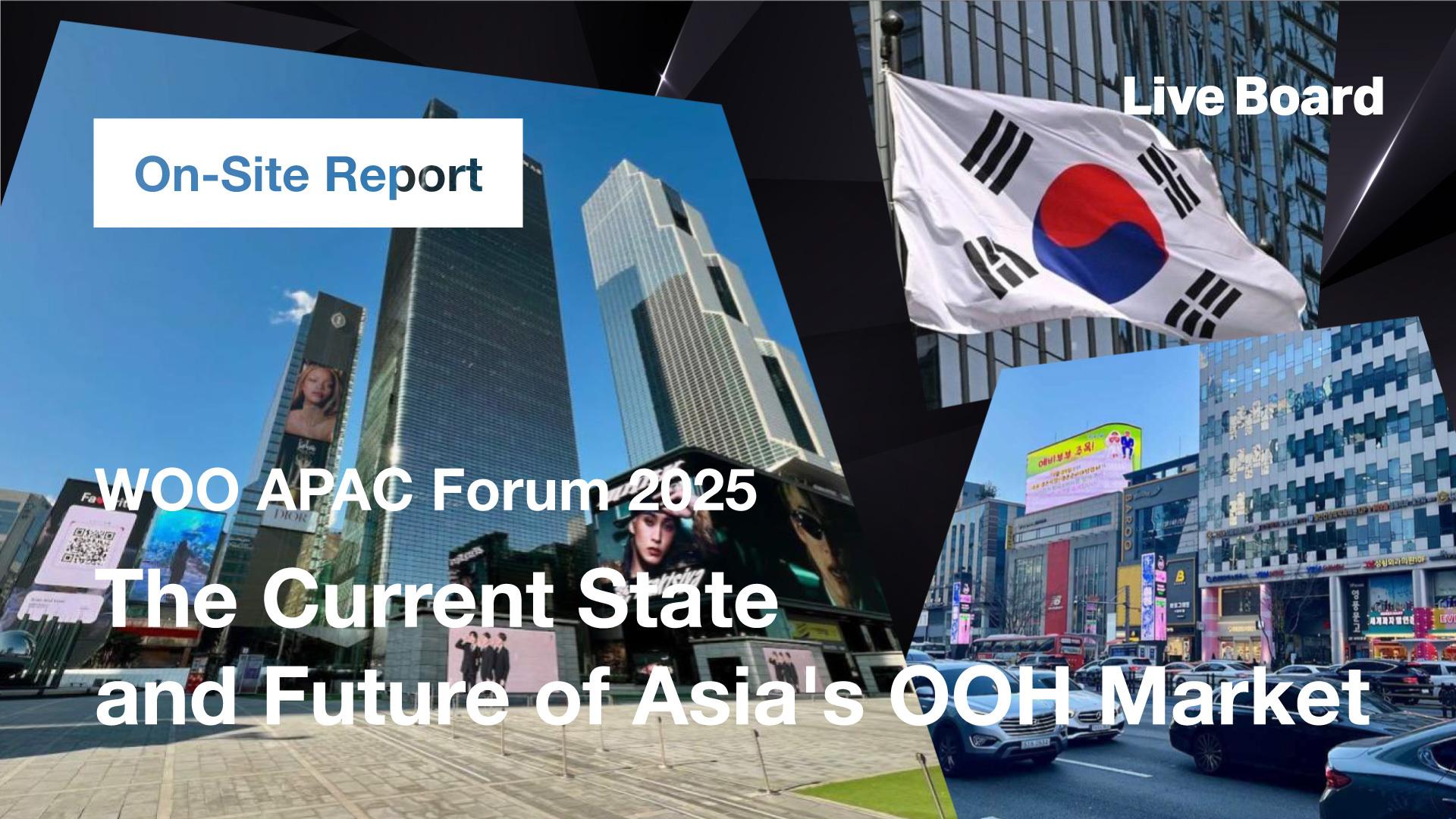
The World Out of Home Organization (WOO), an international OOH association with over 250 member organizations across 125 countries, held its Asia-Pacific regional forum, the "WOO APAC Forum 2025," in Seoul, South Korea, from November 5 to 7, 2025.
At this forum, which saw participation from numerous Japanese companies, Tomohiro Takagi (then President & CEO of LIVE BOARD) took the stage for a joint session with DENTSU INC. This report covers the global trends shared at the forum, the latest developments across APAC markets, and the potential for OOH presented by Japan.
■OOH remains the "Star" medium until the very end.
Tom Goddard, President and Executive Chairman of WOO, stated during the session, "OOH is a medium that remains heroic--a leading role--until the very end."
There are three main reasons behind this.
・The only media maintaining consistent market share
Even amid rapid digitalization, OOH has consistently maintained a stable share of the advertising market.
・Trustworthiness as a physical medium
While online ads and television face credibility challenges, OOH has earned high trust as a physically present medium.
・Scale and experiences unmatched by other media
The sheer size and creative expression deliver an experiential value unique to OOH.
Furthermore, the importance of the APAC market was emphasized when discussing OOH growth. APAC accounts for approximately half of global growth, representing a region with both a massive population and economic scale. It is said that developments in Asia are driving global OOH growth. Within this context, Japan was also positioned as a market playing a crucial role.
Furthermore, the following four points were identified as future growth drivers.
・Significant potential for digitalization
・High affinity with creative fields
・Potential for collaboration with "cities," "public entities," and "regions"
・Advancements in AI and retail media
Tom Goddard's statement that OOH is no longer a "traditional medium but one that continues to evolve into the future" impressed upon us that OOH still holds significant growth potential.
■Can OOH overcome the "5% barrier"? Hope shown by LIVE BOARD
The 5% barrier (also known as the 5% Syndrome) refers to the tendency for out-of-home (OOH) advertising spend to plateau around 5% of total advertising budgets and struggle to increase further. This phenomenon is observed globally, stemming from a structural challenge: OOH advertising is difficult to compare and evaluate using the same metrics as TV or digital advertising.
One key insight into this challenge came from a joint session by LIVE BOARD and DENTSU INC.
This session presented simulation results from DENTSU INC.'s "Cross-Media Planner," who optimizes campaigns across TV × Digital × OOH.
Cross Media Planner is a platform developed by DENTSU INC. in 2015 that automatically calculates optimal media allocation and budget distribution across multiple media channels. In 2023, LIVE BOARD was integrated as the sole OOH partner, enabling true cross-media planning through TV × Digital × OOH.
This simulation, conducted for a ¥100 million advertising campaign in the Tokyo metropolitan area, determined that LIVE BOARD's optimal allocation would be 11.1%. This represents a significant improvement over the "5% barrier" OOH has historically faced, demonstrating that OOH can play a major role in cross-media optimization.
Two key factors supported this evaluation.
・Overwhelming reach covering urban areas and transportation networks
・Precise measurement based on impressions, fully comparable to TV and digital
This achievement was highly praised for evolving OOH into a media format that can be quantified and optimized based on data.
These results suggest that when OOH is integrated into a sophisticated measurement and evaluation framework like other media, the "5% of total budget" assumption may no longer hold.
LIVE BOARD's simulation presented a solid vision for the future of OOH.
■Leading Examples from Around the World: Australia and South Korea's Strategies
Australia: MOVE Establishes Common Ground for OOH Evaluation
Elizabeth McIntyre (CEO / Outdoor Media Association and MOVE) introduced the concept and role of "MOVE," a common currency that measures OOH across Australia using a unified standard.
MOVE (Measurement of Outdoor Visibility and Exposure) is Australia's common audience measurement currency for OOH, launched in 2010. It provides comprehensive coverage of major national OOH media, including roadside, airports, stations, public transportation, commercial facilities, and gas stations. Initially, it operated on a relatively simple model, primarily providing weekly data at the OOH frame level. Nevertheless, since its introduction, industry sales and DOOH revenue have consistently grown. Over more than a decade, MOVE has demonstrated that accurate measurement drives market growth.
And with the release of MOVE 2.0 in 2025, it evolved to provide visibility data broken down by day and time of day, enabling action-based measurement that more closely aligns with real-world behavior. This allows OOH to transition into a media format comparable and evaluable on a person-based level, just like television and online advertising. MOVE's efforts demonstrate that precise, common metrics will sustainably support the growth of the OOH market.
South Korea: Deregulation and Institutional Design Supporting Growth Markets
Daewon Kim (CEO & Founder / PODO Media Network) presented on the theme "Future of DOOH," introducing the current state of the Korean market and specific case studies. Korea's OOH market is the third largest in Asia and seventh largest globally. Despite a digitalization rate of less than 20%, it is a growing market where over half of advertising budgets are allocated to DOOH. A key characteristic of Korea is that DOOH is driving the market both in terms of volume and quality.
The growth of the Korean market is symbolized by the existence of "Free OOH Advertising Zones." These are areas where large-scale advertisements and digital screens are specially permitted, with relaxed regulations on size, brightness, and placement compared to standard areas. In bustling areas like Gangnam and Myeongdong, numerous dynamic media are present, including 3D-capable displays and low-mounted, highly visible screens. These megascreens installed in Seoul and Busan's Free Zones are said to account for roughly half of South Korea's DOOH advertising expenditure, making them an indispensable part of the market today.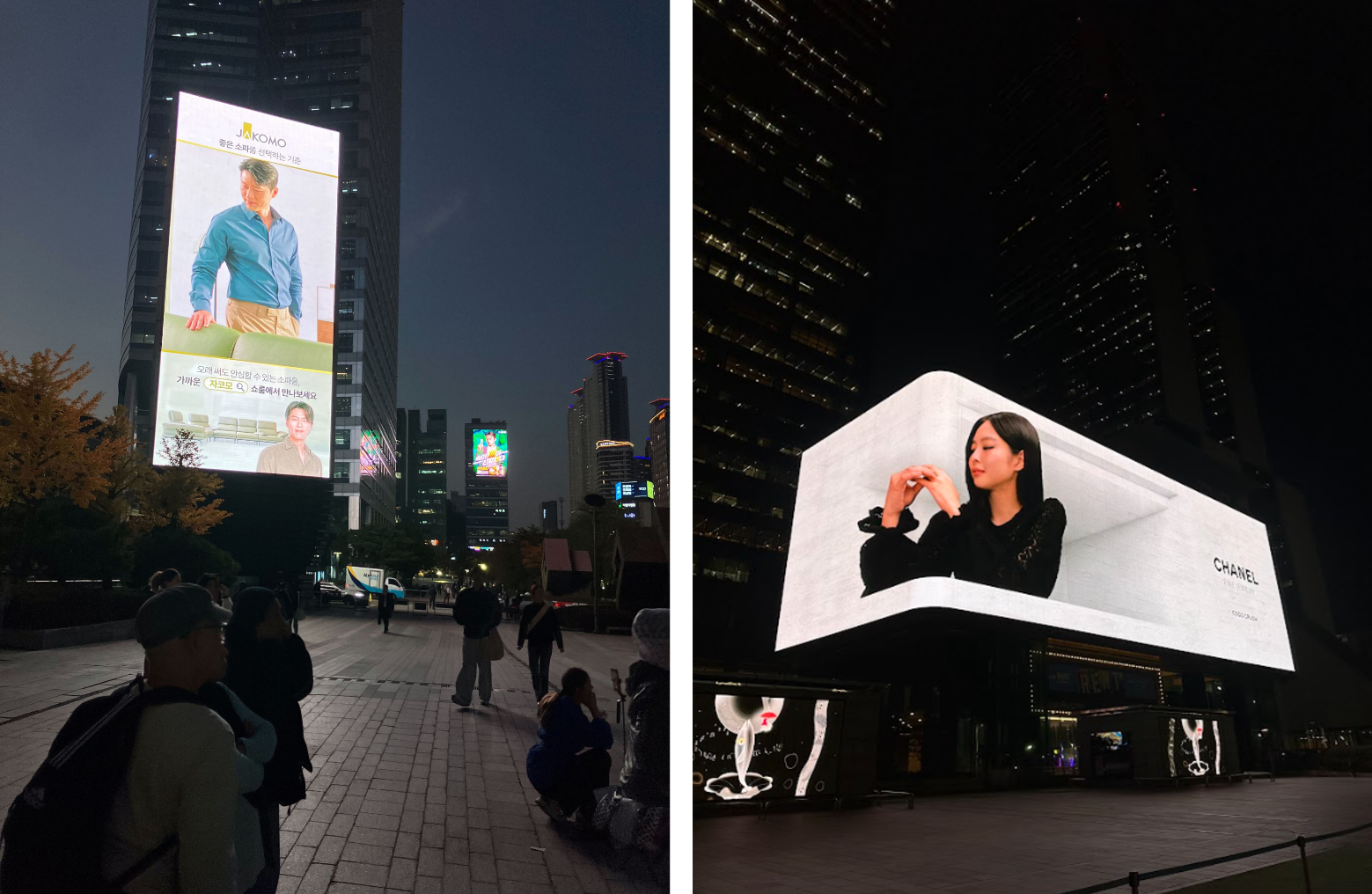 ※Digital screens near Gangnam COEX
(Left) Parna Media Tower (Right) COEX K-POP Square Media
Furthermore, in South Korea, efforts are underway to establish mechanisms for data preparation, standardization, and enhanced transparency, centered around an industry joint committee involving media companies, advertisers, and government agencies. At the same time, challenges such as the proliferation of screens, format differences, and inconsistent measurement methods have become apparent, prompting the initiation of cross-media standardization efforts with government support. The Korean case demonstrates that pursuing dynamism, such as through megascreens, while simultaneously establishing rules and data, leads to sustainable growth in the DOOH market.
■The Current State of Programmatic OOH in APAC
In one session, representatives from South Korea, China, Thailand, Australia, and Japan took the stage to share insights on their respective market conditions, data environments, DSP adoption levels, and progress in industry collaboration. Distinct market developments emerged: South Korea boasts an ID infrastructure of approximately 12 million users, while China hosts over 100 DSPs. Thailand and Australia are seeing shifts in OOH budgets, and Japan introduced positive developments like the establishment of the Japan OOH Measurement Association (JOAA).
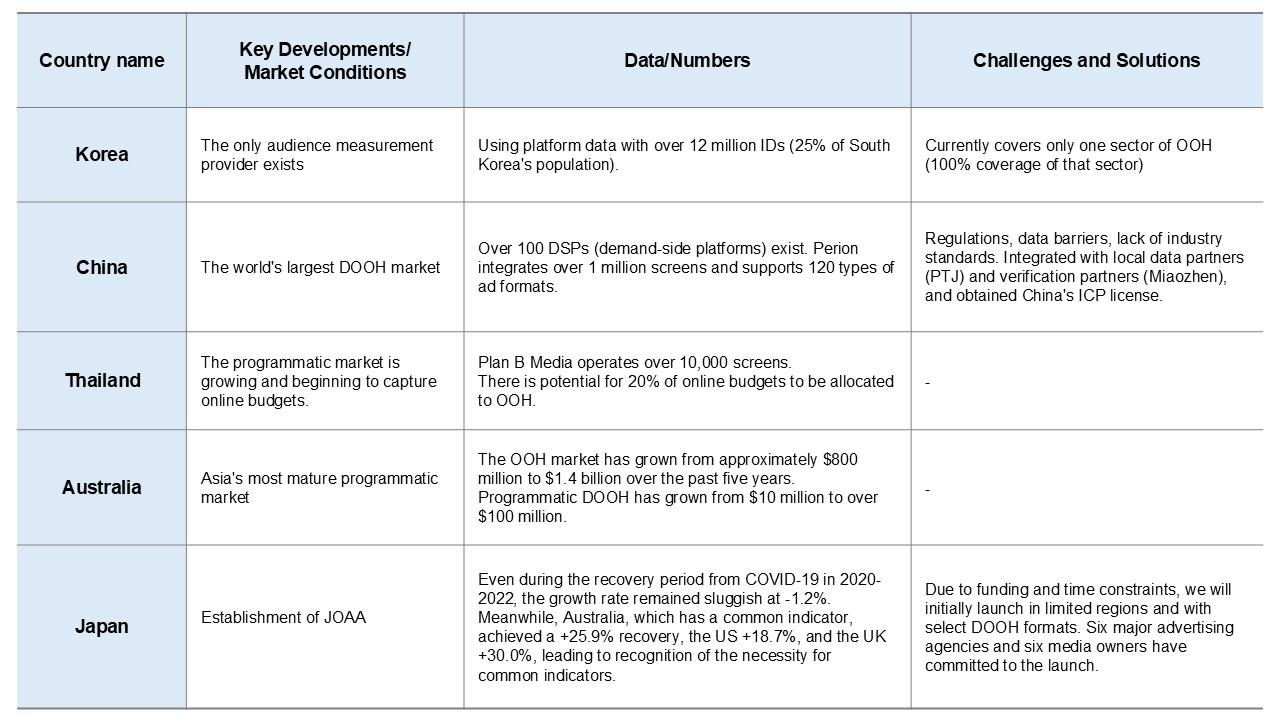
Source:WOO APAC Forum 2025-The Path to Delivering Universal OOH Audience Measurement
Meanwhile, common challenges across countries--such as regulatory differences and data consistency issues--were also discussed. While the entire APAC region is moving forward toward the same goal, there was shared recognition that market maturity varies. Programmatic OOH is steadily advancing in APAC, and to drive growth across the region, it is crucial to further strengthen collaboration and infrastructure development based on this shared understanding.
■Summary
Through this WOO APAC Forum 2025, it became clear that the OOH market in Asia is rapidly gaining momentum. South Korea's OOH in particular was overwhelming in terms of scale, presence, and connection to society, leaving a strong impression.
On the other hand, this growth is not driven solely by sheer size or flashiness. It is the foundational work--in systems, data, and measurement--that serves as the driving force propelling the market forward. As symbolized by Australia's MOVE, the ability to measure has elevated OOH into a strategically evaluable and deployable medium, reaffirming its role in fueling overall market growth.
The Asian OOH market has already moved into its next phase. The WOO APAC Forum 2025 strongly impressed upon Japan that the key to unlocking the next wave of growth lies precisely in the adoption of common metrics and the resulting environment where media can be evaluated and selected based on them.
(Text: Aoi Mitani)
